
Factory-Direct vs. Trading Company: When Each One Actually Wins
- Abdel Benkerroum

- 8 hours ago
- 3 min read
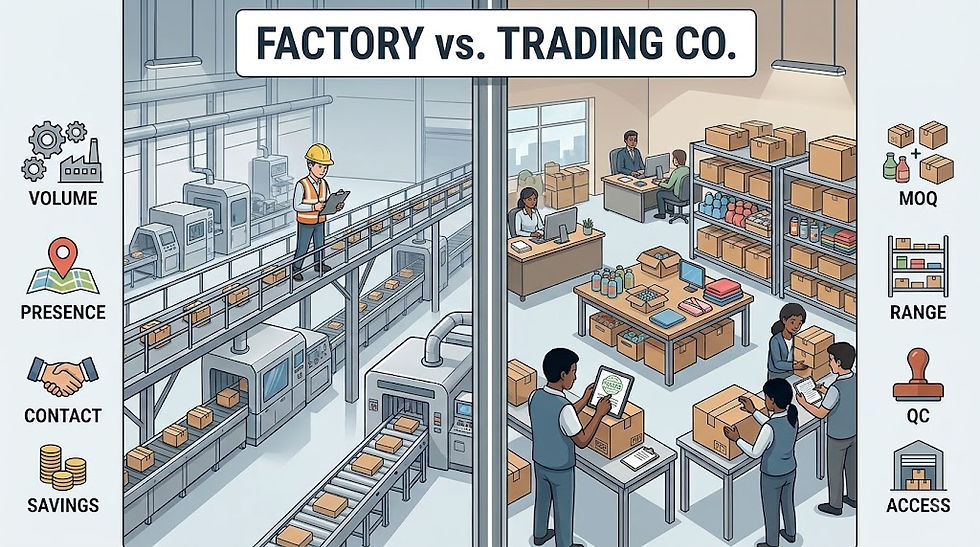
Quick answer: Neither option wins by default. Factory-direct makes sense once your order size earns a factory's real attention and someone can be on the ground managing it. A trading company often wins on price too, through pooled volume, plus access to factories that won't talk to a small buyer, and inspection before goods ship instead of after. The right call depends on your order size, your product, and how much risk you can absorb if something goes wrong.
"Cut out the middleman" sounds like obviously good advice, and sometimes it is. A large, experienced buyer with someone permanently on the ground in China often does better going factory-direct. But for most first-time and mid-size importers, the math and the risk work differently than the slogan suggests.
When factory-direct wins
Picture a buyer placing $200,000 a month with one factory, with someone local walking the production line every week. At that volume, the factory owner takes the call personally. There's no real value left for a middleman to add, and every layer removed is pure savings.
Factory-direct works when three things are true at once: your order size already earns the factory's attention on its own, someone you trust can be physically present on a regular basis, and you know the product well enough to catch a defect yourself. Remove any one of those three, and the savings from going direct usually get eaten by a problem nobody caught in time.
When a trading company wins
Most first orders don't look like that. A first-time buyer ordering three thousand units of a new kitchen gadget will often get quoted more per unit, alone, than a trading company pays at the very same factory, because that trading company is placing two hundred thousand units a year across a dozen clients. The factory isn't being generous. It prices by volume, the same way it always has.
There's a simpler problem too. Some genuinely good factories won't even reply to a small, unknown buyer, because their lines are already booked by repeat clients. A trading company with a standing relationship gets a yes where a cold email gets silence.
And here's the part most sourcing advice skips: what happens when a shipment shows up wrong. A one-time buyer going direct usually has no leverage and no one local to escalate to. A trading company with real inspection at each stage of production catches most problems before the container leaves China, and still has a relationship worth protecting if something slips through anyway.
The honest catch
Picture the other kind of trading company: a name on WeChat, no factory visits, no inspection, a price that's simply the factory's own quote plus 10% for forwarding the email. That's not sourcing. That's paying more for the same risk you'd have had going direct.
The decision isn't trading company versus factory. It's whether the trading company in front of you actually does the work that justifies the fee.
A few questions that cut through the noise
Do they inspect before goods ship, or find out with you when the container arrives?
Will they allow an independent third-party inspection before shipment?
Does the price reflect real volume, or a markup on the same quote you could get yourself?
If something goes wrong, what actually happens next, in writing?
Frequently Asked Questions
Is factory-direct always cheaper? Not usually, unless your order size already matches what a large buyer would place. Below that, a trading company's pooled volume can beat what one small buyer negotiates alone.
How do I know if a trading company is worth the fee? Ask what they inspect and when, and whether they'll allow an independent third-party inspection before shipment. A real answer to both is the difference between a partner and a markup.
We help clients make exactly this call, sometimes toward factory-direct, sometimes not, depending on the order. If you're weighing it on something real right now, happy to look at it with you.